









Home > APFID > About APFID > Visions and Functions

APFID will serve as a core infrastructure for research on infectious diseases and antimicrobial agents through collaborative research, technical development, exchange of ideas and information, and strategic planning in the Asian-Pacific region.
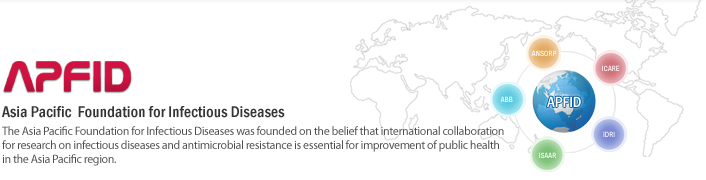
APFID could initiate and support international collaboration in the region through the ANSORP. Collaborative research by ANSORP will produce pivotal data regarding infectious diseases and antimicrobial resistance in the region. APFID could strengthen the capacity of developing country institutions in promoting technical development. Not only through ANSORP but also through the Asian Bacterial Bank (ABB) and Infectious Disease Research Institute (IDRI), APFID will support the research-related activities in the region.
APFID will contribute to disseminate state-of-the-art information on these issues and to exchange ideas between scientists by organizing the International Symposium on Antimicrobial Agents and Resistance every other year. For this purpose, APFID will collaborate with other organizations or academic societies worldwide. Sharing of the information will also be possible through the APFID and ANSORP internet website (http://www.apfid.org).
To be most effective, APFID should be non-governmental, not-for-profit, and independent.
Ultimately, APFID will contribute to strategic planning for the control and prevention of infectious diseases and antimicrobial resistance in the region. APFID will collaborate with other institutions, multinational networks or systems elsewhere in the world for global health issues.
APFID could initiate and support international collaboration in the region through the ANSORP. Collaborative research by ANSORP will produce pivotal data regarding infectious diseases and antimicrobial resistance in the region. APFID could strengthen the capacity of developing country institutions in promoting technical development. Not only through ANSORP but also through the Asian Bacterial Bank (ABB) and Infectious Disease Research Institute (IDRI), APFID will support the research-related activities in the region.
APFID will contribute to disseminate state-of-the-art information on these issues and to exchange ideas between scientists by organizing the International Symposium on Antimicrobial Agents and Resistance every other year. For this purpose, APFID will collaborate with other organizations or academic societies worldwide. Sharing of the information will also be possible through the APFID and ANSORP internet website (http://www.apfid.org).
To be most effective, APFID should be non-governmental, not-for-profit, and independent.
Ultimately, APFID will contribute to strategic planning for the control and prevention of infectious diseases and antimicrobial resistance in the region. APFID will collaborate with other institutions, multinational networks or systems elsewhere in the world for global health issues.